I'm Finally Starting a Blog(and Here's What I've Been Building)
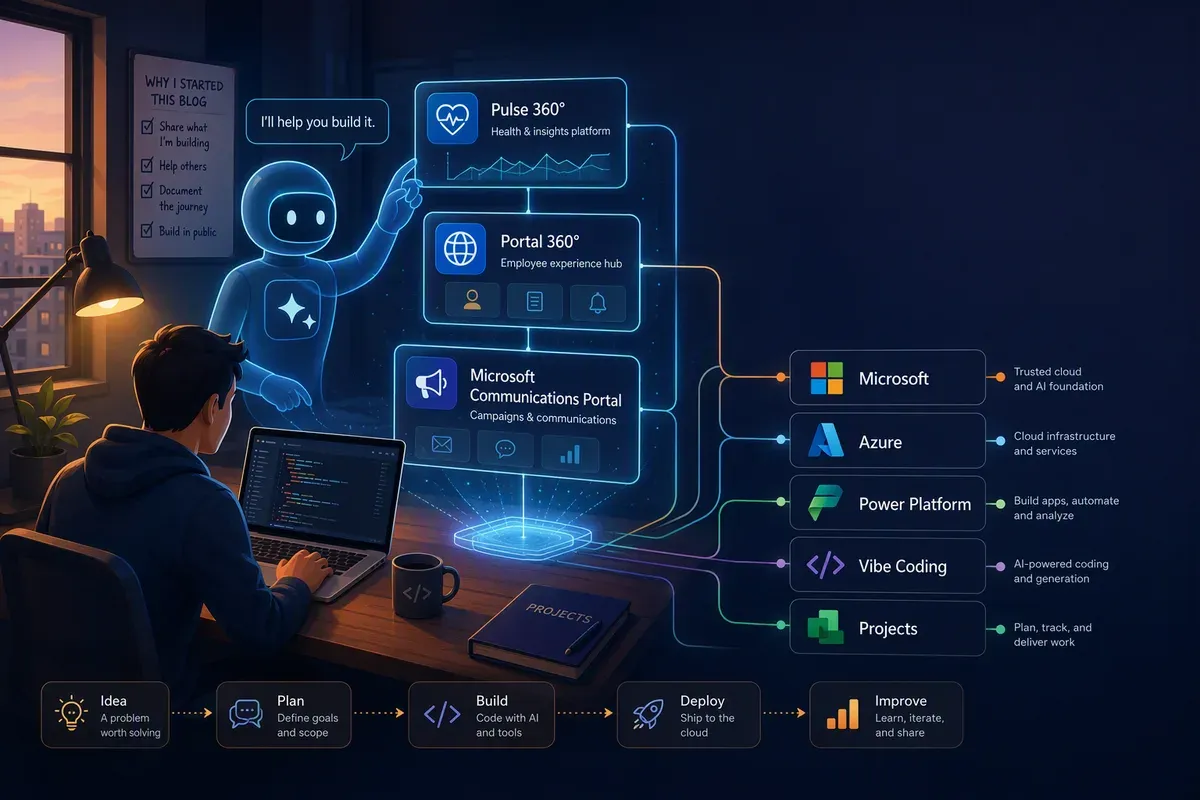
I’ve been saying “I should really start a blog” for about three years now. The domain has been sitting there. The half-written intro posts have come and gone. And every time I sat down to actually publish something, I found a reason not to.
So consider this the reason I finally did: I’ve built a handful of things lately that I’m genuinely excited about, and I wanted a place to talk about them that wasn’t a LinkedIn post buried by the algorithm ten minutes after I hit publish.
If you work anywhere near the Microsoft cloud (Microsoft 365, Azure, Power Platform), a few of these might be useful to you too. Here’s a tour.
Pulse 360°: one dashboard for every Microsoft update stream
If you’ve ever tried to keep up with Microsoft’s pace of change, you know the problem: the news lives in a dozen different places. Message Center, the M365 roadmap, Azure Updates, the Fabric roadmap, the Power Platform release planner, MSRC security advisories, a pile of product blogs. Nobody has time to check all of them.
Pulse 360° is my answer to that. It pulls all of those official Microsoft update streams (Microsoft 365, Azure, Fabric, Power Platform, Dynamics 365, Copilot, and MSRC) into a single, fast, filterable dashboard, so “what changed that affects me this week” is one search instead of nine tabs.
Under the hood it’s a Next.js 16 app (App Router, React 19, TypeScript, Tailwind CSS 4). Server Components do the heavy lifting and route handlers act as a server-side proxy for the cross-origin and bot-protected feeds. If you want to poke at it, it’s live at mspulse360.app.
You can find the source on GitHub: github.com/russrimm/Pulse360. There’s a longer write-up on the Pulse 360° project page if you want the full feature tour.
Portal 360°: one console for every Microsoft admin portal
This one’s still cooking, so I’ll keep it brief. Portal 360° folds the whole sprawl of Microsoft admin portals (Entra, Intune, Azure, Microsoft Foundry, Defender, Purview, Power Platform, Copilot Studio, Fabric, Exchange, Teams, SharePoint, and the Microsoft 365 admin center) into a single authenticated, audit-friendly workspace. Instead of keeping a dozen tabs open and signing in to each one separately, IT and MSP teams get one console with centralized visibility, cross-service actions, and audit-ready operations.
It’s a Next.js 16 / React 19 / TypeScript app secured with NextAuth (Auth.js) v5, built on a Backend-for-Frontend architecture. Every privileged call stays server-side, behind per-route authentication and least-privilege scopes drawn from a single centralized map, and it uses delegated tokens so the app acts as the signed-in admin rather than a faceless service principal. It’s a private repo for now while I harden it. This much reach across this many privileged APIs is a big attack surface, and I’d rather ship it when the security story is airtight.
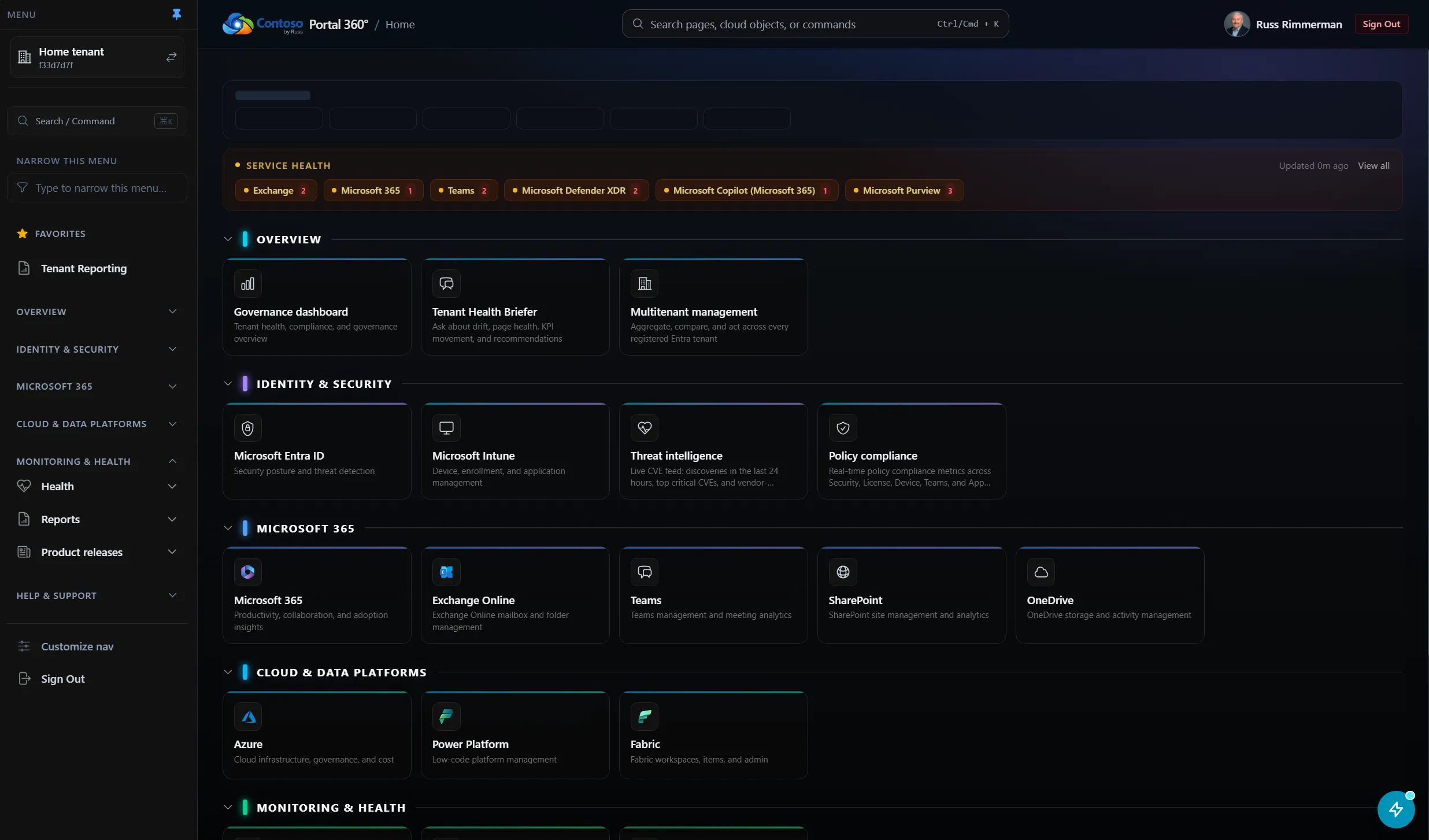
Here’s the home dashboard: service health and platform tiles for every Microsoft cloud in one place:
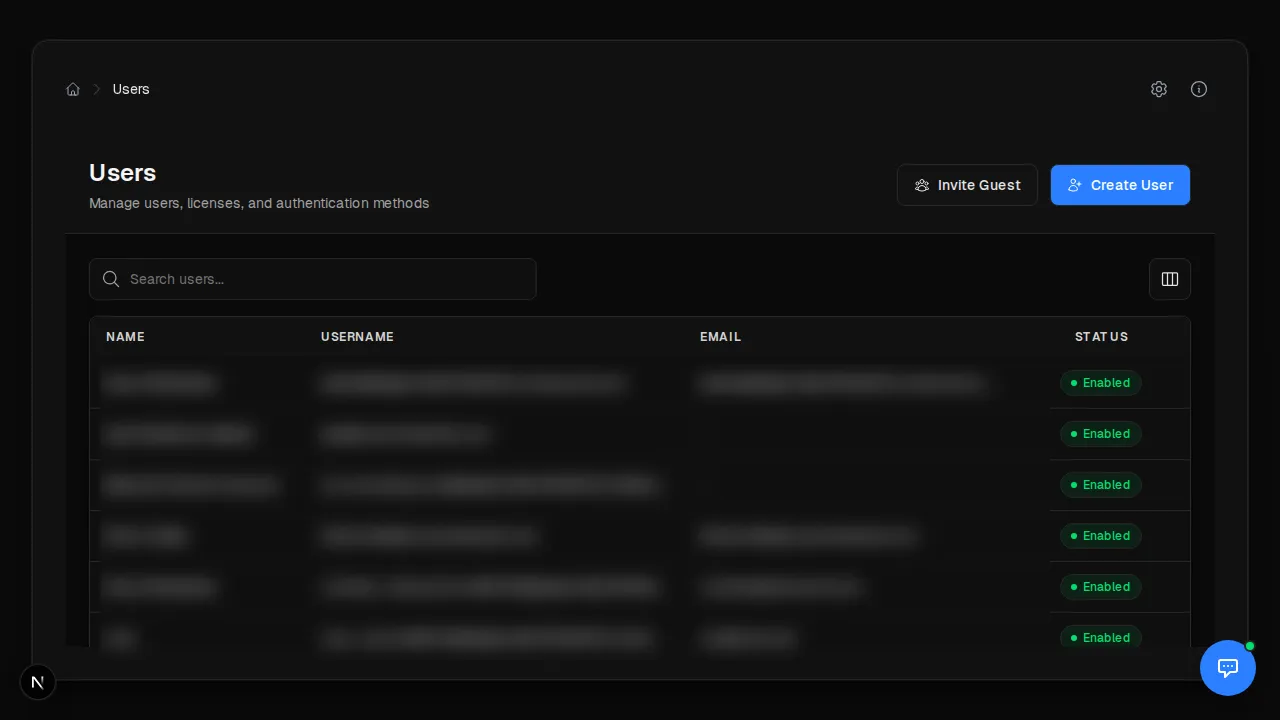
The identity surface covers users, groups, apps, PIM, Conditional Access, and audit logs, all backed by Microsoft Graph:
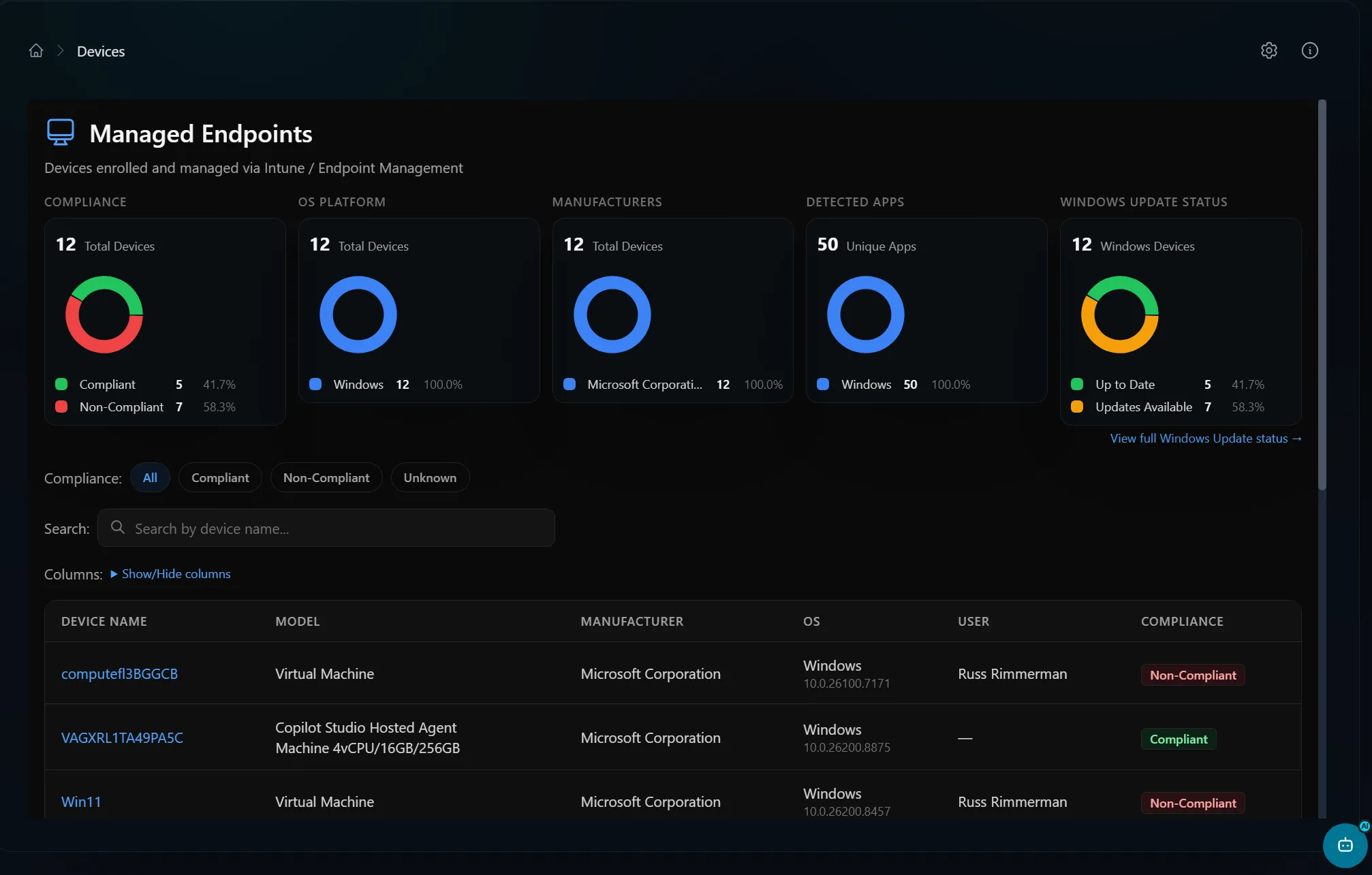
Microsoft Intune drives the device surface: inventory, compliance, and configuration state for every managed device:
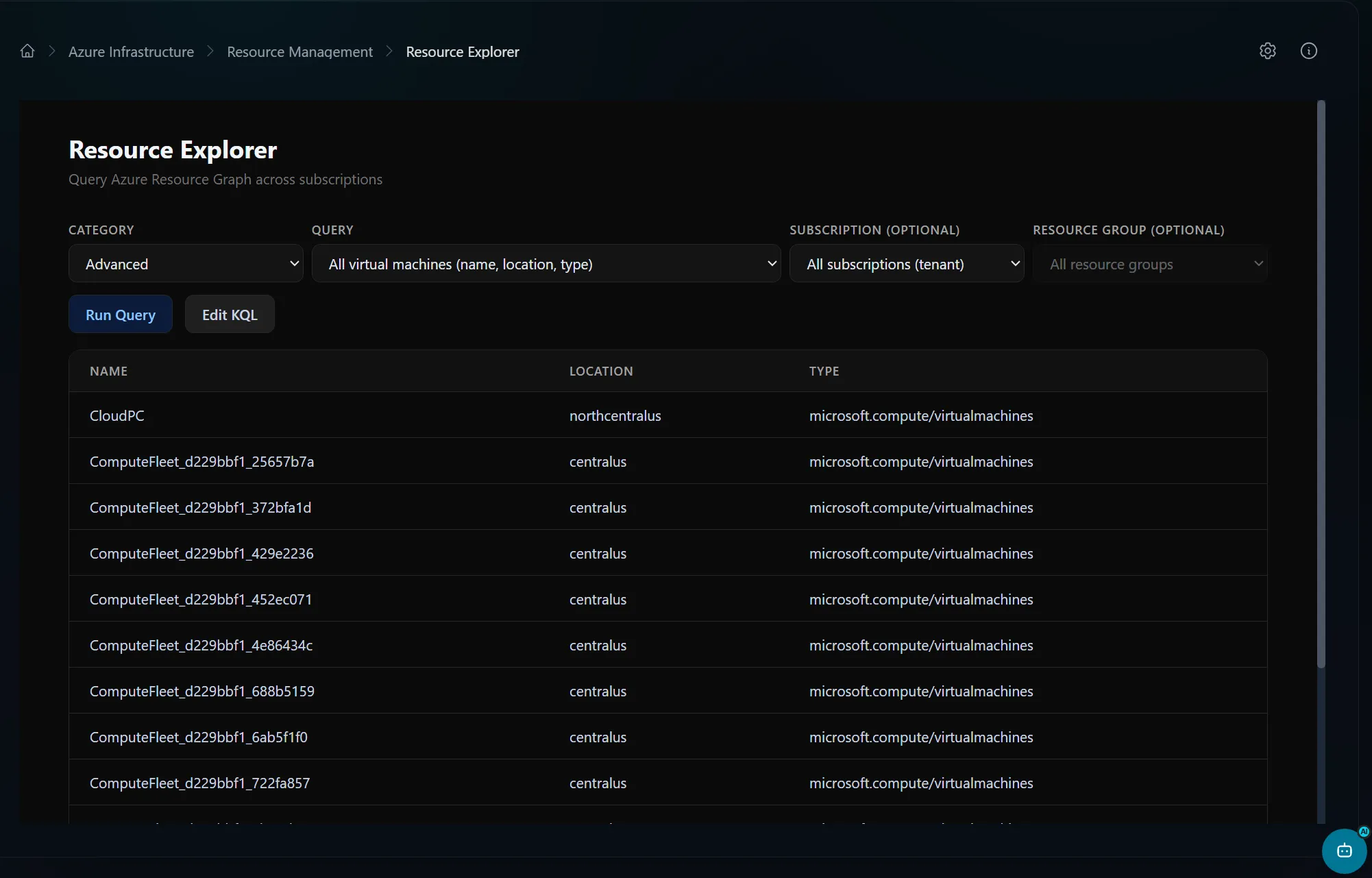
Azure coverage spans resources, networking, VMs, policy, cost, and monitoring, with an Azure Resource Graph explorer:
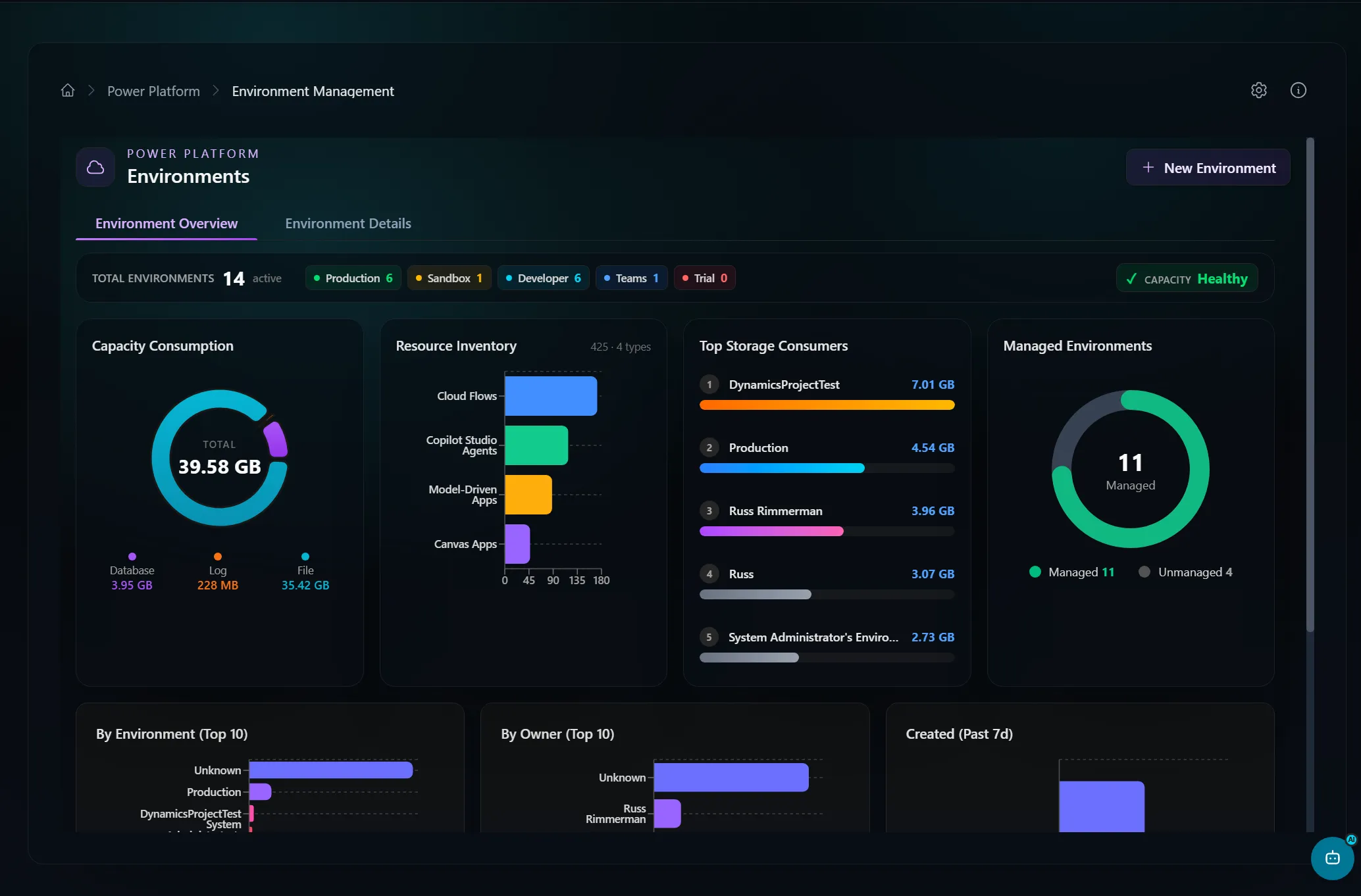
The Power Platform surface handles environments, Copilot Studio, DLP, governance, and Dataverse analytics:
A handful of other surfaces round out the console:
- Secure Score monitoring: current posture, improvement actions, and category breakdown, optionally enriched by Defender for Endpoint.
- AI and compliance: Microsoft Foundry for model and agent work, Microsoft Purview for compliance posture and data loss prevention.
- Collaboration: Exchange mailboxes and folders, Teams, and SharePoint.
- Vulnerability data: CVE search over the NIST NVD API, joined against
Intune
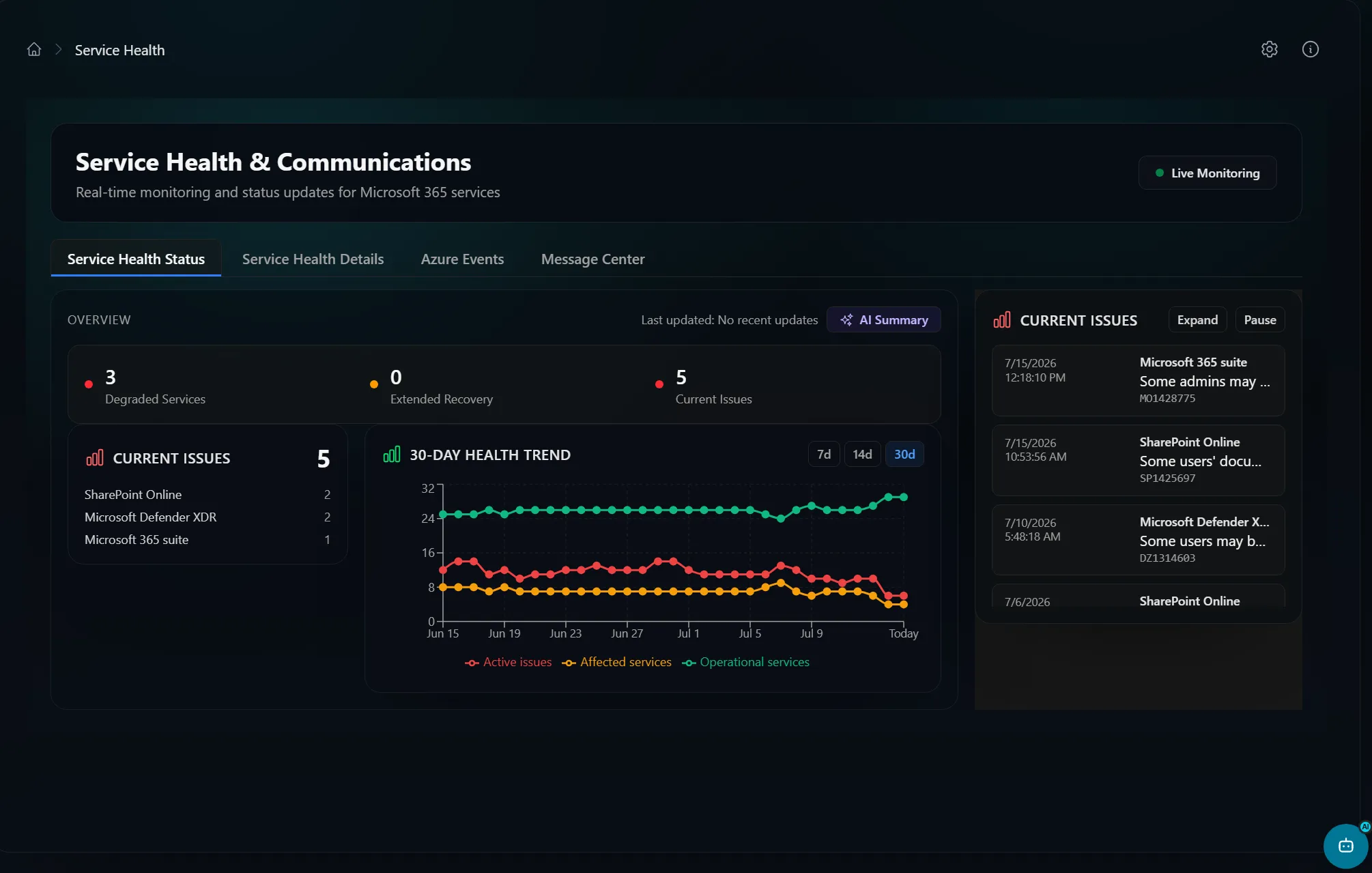
managedDevicesto estimate exposure, with an optional Defender for Endpoint Plan 2 path for authoritative per-CVE machine counts. - Real-time service health: issue counts, degraded and extended-recovery tracking, and clickable incident detail.
- Security by default: RBAC on top of Entra sign-in, CSRF protection with constant-time token comparison, a Redis-backed sliding-window rate limiter, and server-side token storage the browser never sees.
- Self-healing schema mirrors: a weekly GitHub Actions workflow diffs the Power Platform tenant-settings registry against Microsoft’s upstream sources and opens a PR when they drift.
That’s the short version. I wrote a full deep dive on it, Portal of Portals: One Console for Every Admin Portal, covering the architecture, the security model, and every surface it touches. The Portal 360° project page has a shorter feature tour if that’s all you’re after.
Microsoft Communications Portal: a single pane of glass you can self-host
The Microsoft Communications Portal grew out of a request I kept hearing from customers: they wanted one place to see all the Microsoft updates that affect them (Power Platform release plans, the Microsoft 365 roadmap, Azure announcements, the Fabric roadmap, tenant-specific Message Center posts, and Service Health incidents) without bouncing between half a dozen admin centers. And critically, they wanted something they could deploy on their own infrastructure.
So that’s what this is: a single-pane-of-glass web app backed by a tiny Node.js server that proxies the upstream APIs and handles the Microsoft Graph authentication. Six of the nine pages work immediately with no credentials at all; only the Graph-backed pages (Message Center, Service Health) need an Entra app registration.
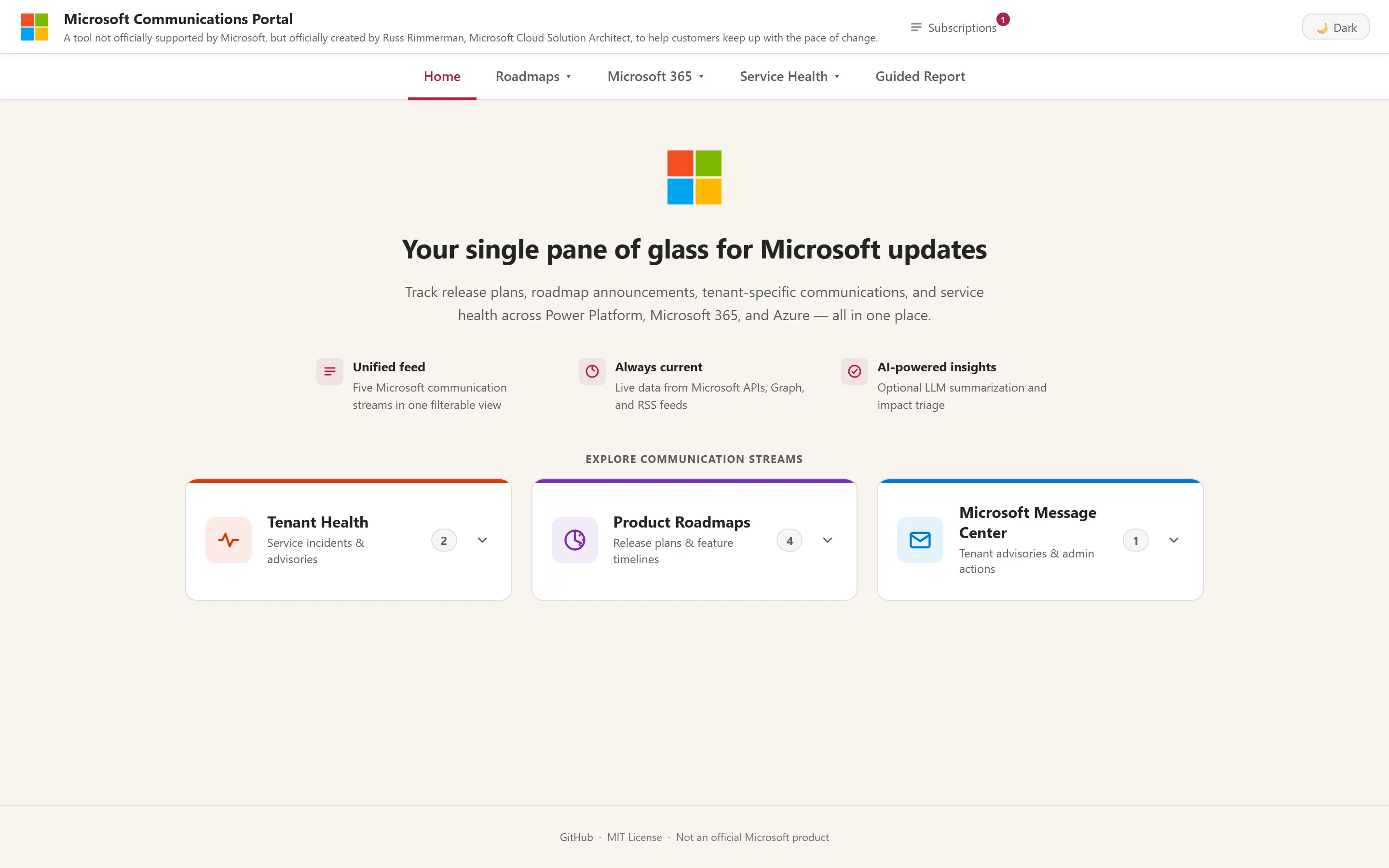
Here’s the home dashboard: every communication stream in one filterable view:
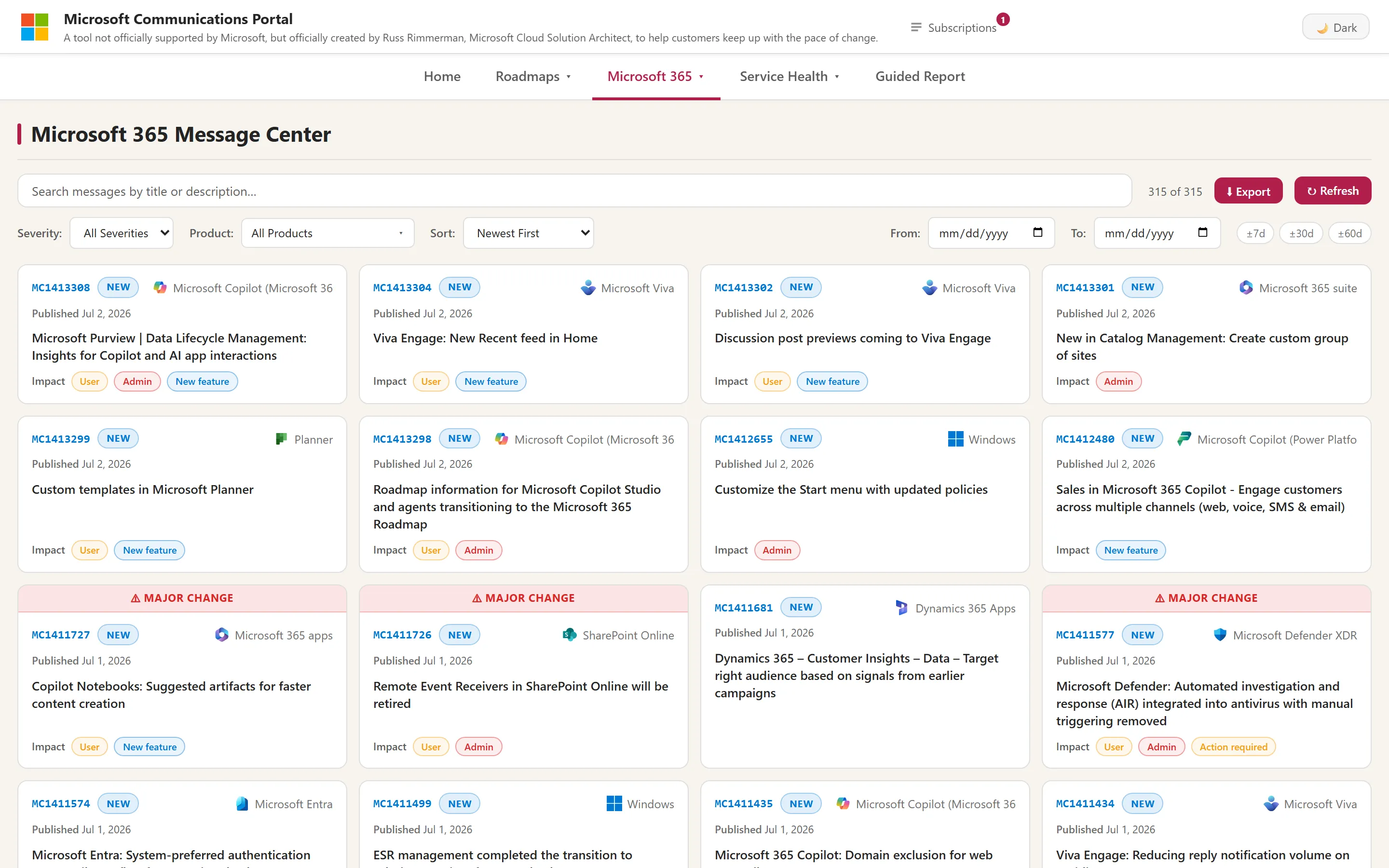
The Message Center page pulls tenant-specific Microsoft 365 announcements straight from Microsoft Graph, filterable by severity and date:
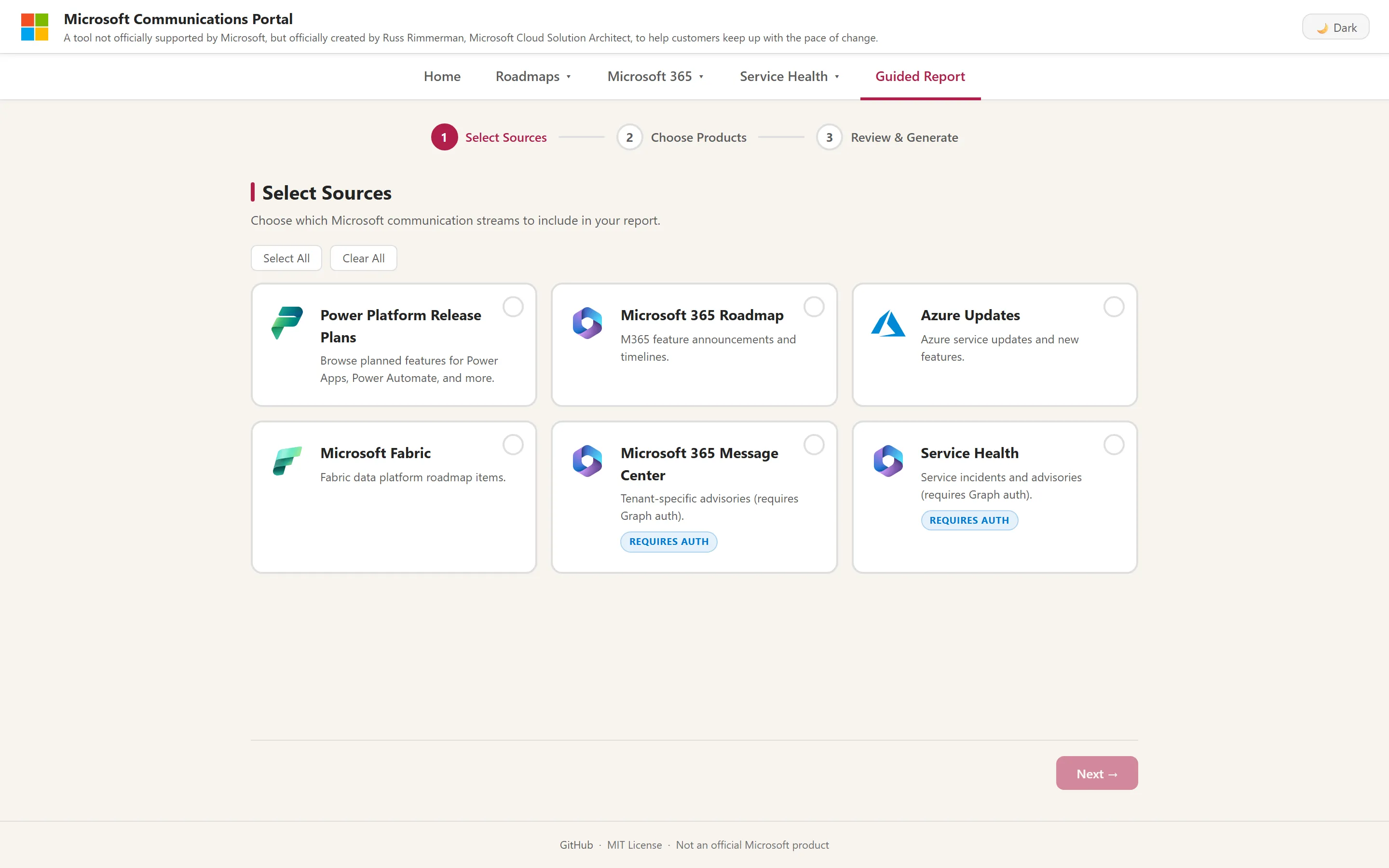
And my favorite feature: the Guided Report builder. It walks you through picking sources and produces a clean, shareable report you can export. There’s even one-click export to a self-contained HTML file you can paste straight into an Outlook email:
There’s also an optional AI layer that produces a “top 5 most impactful changes this week” digest and can summarize any individual announcement into plain language with an impact rating and an admin-action flag.
It’s MIT-licensed and not an official Microsoft product, just a reference implementation I put together to help customers keep up. Source and setup docs are here: github.com/russrimm/MicrosoftCommunicationsPortal, and the Microsoft Communications Portal project page covers the architecture in more depth.
Why I build these (and why I’m writing about them)
If you’re noticing a theme here, “Microsoft ships a lot, and it’s hard to keep up,” you’re right. That’s the itch behind most of what I make. I’m a Cloud Solution Architect, and the single most common thing I hear from customers is some version of “how do I stay on top of all this change?”
The other thing worth admitting: I’m not a career developer. Most of this got built by describing what I wanted and letting AI do the heavy lifting, then poking at it until it worked. What made that possible isn’t the code the model types, it’s the harness around it: the rules of engagement I hand the model before it starts. I unpacked how that works, and what it took to get there, in Coding with AI.
So that’s the plan for this blog: the things I’m building, the Microsoft cloud news worth paying attention to, and what I’m learning about building software with AI as a co-pilot rather than fighting a compiler by myself.
If any of these projects are useful to you, or you want to swap notes on building this kind of thing, I’d love to hear from you. Reach out anytime. Thanks for reading the very first post. There will be more.
Get the latest learnings
Occasional notes on Azure, AI, and cloud architecture. No spam, unsubscribe anytime.
Related articles
Power Apps Code Apps: Your Code, Power Platform's Guardrails
Code apps let you build a React or Vue app in your own IDE and run it on Power Platform, with Entra ID sign-in, 1,400+ connectors, and DLP handled for you.
Finding GitHub Copilot Harness Agents Before PPAC Shows Them
The Power Platform admin center still doesn't flag which Copilot Studio agents run on the GitHub Copilot harness. The isCLIAgent property does, and Microsoft has now published governance guidance built on it.
Vibe Code Your Blog, Part 2: Build It, Then Ship It to Azure
Deploy an Astro blog to Azure Static Web Apps with OIDC, least-privilege access, and a walkthrough of the resources and trade-offs.
Comments
Comments are hosted by GitHub Discussions. Loading them connects your browser to giscus.app and GitHub.